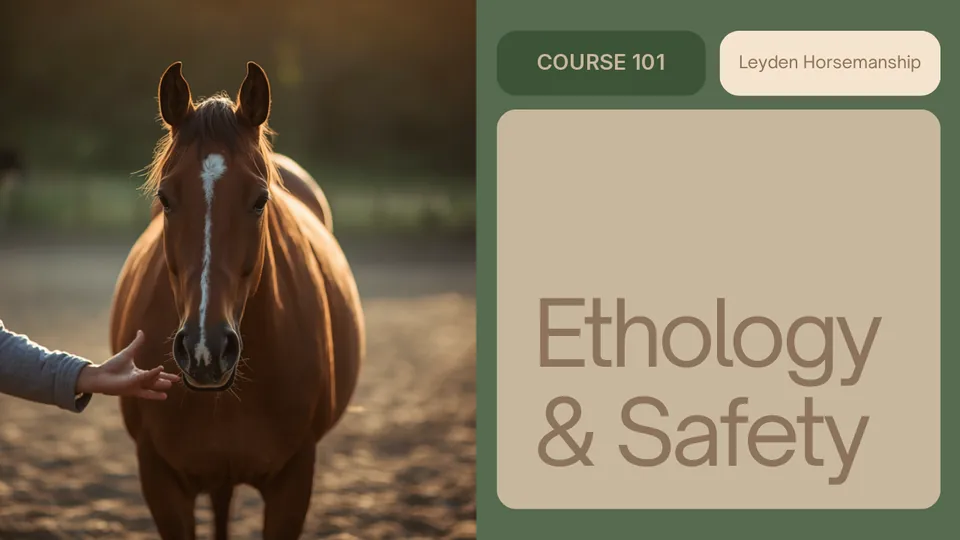
Course 101: Ethology & Safety
The second course of the Level 1 Foundational Horsemanship Certification. Course 101 is about the horse's mind and your safety, in that order and inseparably. You will learn how a prey animal sees the world, how to read ears, eyes, mouth, tail, and above all the feet, and why the horse is a mirror of the person handling it.
Then the skills: the catch as a conversation the horse chooses to join, leading with feel, tying with knots that always release under load, bridling without a fight, and the beginnings of round pen work, where a horse hooks on and chooses you. Every lesson is built on the barn safety rules at Ocean View Stables, and the certification at the end tests the judgment that keeps you and the horse safe.
Soft is strong. Clarity is kindness.
Course Locked
| Responsible | Zachary Leyden |
|---|---|
| Last Update | 10/20/2026 |
| Completion Time | 7 hours 26 minutes |
| Members | 6 |
-
Safety First (empty)7Lessons · 1 hr 1 minSection 1 of 7. A thousand pound animal with a five foot sideways spook does not need to mean you harm to hurt you badly. These are the rules at Ocean View Stables, the reason behind each one, and the three distances that decide whether you are safe behind a horse.
-
Watch with Zachary: The Rules You Agree to at the Gate
You agree to these rules the moment you walk through the gate. Learn what to wear, how to move, and the safe distances behind a horse, so your first barn day is a safe one.
Preview -
The Barn Safety Rules at Ocean View StablesHelmets, boots, phones, the three adult rule for mounted campers, and the passing distance behind a horse. The non negotiables. Read this one before your first barn day.Preview 10 xp
-
Watch: Staying Safe Around HorsesThe essentials in one pass, for someone who has never stood next to a horse. Worth watching the night before you come.Preview
-
Watch: What to Wear to a LessonA practical rundown of lesson clothing and footwear. Check it against our barn rules, which are stricter in a couple of places.Preview
-
Watch: Keeping a Horse Out of Your SpaceA short demonstration of moving a pushy horse back out of your bubble without escalating.Preview
-
Watch: What Keeps You Safe Around HorsesWhat actually keeps people safe around horses, explained calmly. Watch this after you have read the barn rules, not instead of them.Preview
-
Watch: Bryan Neubert - Safe Handling Under PressureBryan Neubert grew up with Tom Dorrance as his mentor. Watch him keep a green colt safe and calm around a frightening stimulus, using exactly the awareness the safety lessons above describe.Preview
-
-
How the Horse Sees the World (empty)8Lessons · 1 hr 6 minSection 2 of 7. Almost every horse problem is a translation problem. Three hundred and fifty degrees of vision, two blind spots, a nervous system built for flight, and a body that reads yours before you have said a word. Learn to read the animal and most of the training in this program stops looking like training.
-
Prey Animal: Vision, Flight, and the HerdThree hundred and fifty degrees of vision, a binocular wedge of sixty, and two blind spots. Why the spook goes sideways, and why the middle distance behind a horse is the dangerous one.Preview 10 xp
-
Reading Body Language: Ears, Eyes, Mouth, Tail, FeetEars, eyes, nostrils, tail, and above all the feet. Five signals, at least three before you conclude anything, and the difference between a dozing hind foot and a cocked weapon.Free account 10 xp
-
The Horse Is a MirrorThe horse hands back whatever you brought in with you. Sixty seconds at the gate, three exhales, and why frustration is more dangerous than fear.Free account 10 xp
-
The Phases: Whisper, Conversation, Boundary, RewardWhisper, conversation, boundary, reward. Always start at the whisper, even on a dull horse, and understand exactly what you teach the moment you skip it.Free account 10 xp
-
Watch: How Horses Read Body LanguageHow horses read human body language, demonstrated. Watch yourself in it, not just the horse.Free account
-
Watch: Warwick Schiller - The Herd-Bound HorsePrey Animal: Vision, Flight, and the Herd explains why isolation stresses a prey animal. Here is what that looks like at full volume: an extremely herd-bound horse, and why the problem is not really the separation.Free account
-
Watch: How a Horse Sees, and Where It Can'tBennett Equine Services, an equine veterinary practice in Oakdale, California, gives a quick, basic lesson on where a horse can and cannot see. As you watch, note where the blind spots are and think about how that should change the way you approach a horse and move around him.Free account
-
Watch: Buck Brannaman on Reward and TimingIn this short clip from 7 Clinics with Buck Brannaman, Buck coaches a rider through backing up and makes one point again and again: slack in the rein is the reward, so when you give it tells the horse what was right. When he says he loves being ignored he is joking in the horse's voice; a release given while the horse is still resisting, or quitting before he tries, teaches him to ignore you. Watch for the moment the horse softens and how fast the release follows; that is the reward phase from The Phases: Whisper, Conversation, Boundary, Reward, done on horseback.Free account
-
-
The Catch and the Draw (empty)6Lessons · 47 minSection 3 of 7. Anyone can corner a horse. The measure of a horseman is a horse that walks toward the halter. Approach and retreat, the forty five degree line, and why walking out of the field empty handed is sometimes a pass.
-
Watch with Zachary: The Horse That Walks to You
Anyone can corner a horse. Learn the angle, the draw and the patience that bring a horse walking toward the halter, and what to do when it walks away. Press play before your next catch.
Free account -
The Catch as a ConversationForty five degrees to the shoulder on a curved line, halter carried low and folded. The rope goes over the neck before the nose goes in the halter, and food is never part of it.Free account 10 xp
-
When the Horse Will Not Be CaughtSix to ten cycles of approach and retreat is normal. Chasing never is. When to suspect pain, when to stop, and why walking away without the horse can be the right answer.Free account 10 xp
-
Watch: Catching the Hard-to-Catch HorseA hard to catch horse worked through patiently in real time. Notice how much of it is the human standing still.Free account
-
Watch: Bryan Neubert - The First CatchYou watched the draw work on a broke horse. Now watch Neubert catch and lead an unhandled youngster for the first time in its life. As he says: you will not get a second chance at a first impression.Free account
-
Watch: Craig Cameron - Catching as a Daily HabitRanch horsemanship's version of the catch: every approach a small training moment. Compare his habits to the draw you learned; the good ones agree on more than they differ.Free account
-
-
Leading With Feel (empty)5Lessons · 30 minSection 4 of 7. Leading looks like the simplest thing in the barn, and it is where most people quietly teach a horse to push them around. Position, pace, the bubble, and the gate procedure that keeps both of you out of trouble.
-
Watch with Zachary: A Smile of Slack in the Rope
Where you stand when you lead decides almost everything. Learn the position, the rope hold and the bubble that keep you off the horse's feet and out of trouble. Press play before you pick up a lead rope.
Free account -
Position, Pace, and the BubbleLevel with the throat, an arm's length off, a visible smile of slack in the rope. The position that keeps you out of the kick zone and keeps the horse honest.Free account 10 xp
-
Leading Through Gates and Past TroubleGates, thresholds, and passing other horses. Open fully, stand on the hinge side, turn the horse to face the gate before you close it, and never pass head to tail.Free account 10 xp
-
Watch: Groundwork With Feel - Buck BrannamanBuck Brannaman on the ground. The clearest demonstration of feel in this course, and worth returning to after Course 102.Free account
-
Watch: Bryan Neubert, Leading Up on FootBryan Neubert, who learned from Tom Dorrance and Ray Hunt, helps a sticky horse learn to lead up freely, in a short preview from The Eclectic Horseman. Watch the order he asks in: body and hand first, then he waits, adds a light tap only if nothing happens, and the moment the horse tries he goes with him instead of pulling him around. He lets this horse get ahead of him to build forward; with a school horse you will keep the leading position your instructor shows you, but asking light and rewarding the try is the same.Free account
-
-
Tying and Knots (empty)7Lessons · 57 minSection 5 of 7. A tied horse that panics is one of the most dangerous situations on a property, and it is almost always created by a person weeks earlier. Where to tie, what to tie to, the knot that always releases under load, and the horse that has learned it can win.
-
Watch with Zachary: Tying and Bridling Without a Wreck
Learn where and how to tie, the quick-release knot that lets go under load, what the bit actually sits on, and how to unbridle without banging a tooth. Press play before your next tie or bridle.
Free account -
Where and How to TieWither height or above, an arm's length of rope, and an anchor that cannot move. Never a fence board, never a gate, never two horses within reach of each other.Free account 10 xp
-
The Quick-Release Knot and the BowlinePull a bight through, not the end. One tuck, never two. The quick release knot and the bowline, and the exact difference between a knot that saves a horse and one that looks identical and jams.Free account 10 xp
-
The Horse That Pulls BackThe cause is almost always a history of winning. What to do in the moment, what never to do, and why the retraining happens in hand and never on a tie rope.Free account 10 xp
-
Watch: The Quick-Release KnotThe quick release knot tied slowly and clearly. Pause it, tie along, and repeat until your hands own it.Free account
-
Watch: Warwick Schiller - Teaching a Young Horse to TieThe missing piece behind every tying lesson above: the horse must first be taught to stand tied. Warwick builds it from patience and preparation, never asking for anything the horse does not already know.Free account
-
Watch: Warwick Schiller on Avoiding Tying TraumaWarwick Schiller explains why he never ties a horse until it can already give to pressure on the lead rope, stay calm instead of spooky, and stand still. Watch for his second rule, which applies every time you tie a school horse: never do anything to a tied horse, like hosing, saddling or picking up feet, that he is not already comfortable with untied. The first couple of minutes are a cycling and pandemic analogy, and he does not show the knot itself, so use the steps in the lesson for that.Free account
-
-
Bridling (empty)5Lessons · 41 minSection 6 of 7. The bit sits on bare bone covered by thin gum. Everything here follows from that fact: how a snaffle differs from a curb, how to size and fit a bridle, and how to take one off without banging a tooth and creating a head shy horse.
-
Parts of the Bridle and the BitThe bars of the mouth are bone under thin gum. A snaffle is defined by where the rein attaches and not by a joint, and a curb is not a control upgrade.Free account 10 xp
-
Unbridling Without a BangHalter on first, reins over, throatlatch, noseband, crownpiece, then lower and wait. Two or three seconds for the horse to drop the bit itself. This is where head shy horses are made.Free account 10 xp
-
Watch: Bridling the Hard-to-Bridle HorseWorking with a horse that has learned to avoid the bridle. Watch how much of the fix happens before the bridle is even picked up.Free account
-
Watch: Buster McLaury - Correct HalteringBuster McLaury rode for years with Ray Hunt. Two minutes on halter and bridle mechanics done so the horse stays comfortable. Most bridling problems, he will tell you, are human error.Free account
-
Watch: Ken McNabb, Bridling Kindly and Fitting the BitKen McNabb, a Wyoming ranch horseman, shows a comfortable way to bridle and then how the bridle should fit. Watch how he holds the bit with his fingers and slips a thumb into the corner of the mouth so the bit never grinds on the teeth, and how he brings the headstall over each ear gently. Then notice where he wants the bit to sit (just touching the corners of the mouth), the browband between the eye bones and the ears, and a throat latch loose enough for your fingers. At the barn, staff set the bridle for each school horse; bridle gently, check the fit you learned in Parts of the Bridle and the Bit, and speak up if something looks tight.Free account
-
-
The Round Pen (empty)5Lessons · 58 minSection 7 of 7. The round pen is the most misused tool in horsemanship. Used well it is a conversation about pressure and space. Used badly it is a treadmill that exhausts a horse into compliance. The driveline, the six signs of hooking on, and the hard limit on time.
-
Round Pen Safety and SetupFifty to sixty feet across, panels above five feet, and the driveline running through the withers. Setup and safety before any horse goes in.Free account 10 xp
-
Hooking On in the Round Pen: From Flight to ConnectionInside ear, head lowers, lick and chew, circle shrinks, eye stays, horse turns in. Six signs in order, each one answered by taking pressure off. Ten to twenty minutes maximum, and never until the horse quits.Free account 10 xp
-
Watch: The Hooking-On ProcessThe hooking on process demonstrated. Watch for the moment the horse decides, which comes well before it turns in.Free account
-
Watch: Monty Roberts - Join-Up ExplainedThe most famous round-pen method in the world, narrated by the man who named it. Watch it after the hooking-on video and compare: where Monty sends the horse away to invite it back, the Leyden Way keeps the conversation quieter. Both read the same language.Free account
-
Watch: Warwick Schiller, A Common Hooking-On MistakeWarwick Schiller shows the most common hooking-on mistake: a horse that cuts across in front of you is leading you, not following you. Watch where his gelding goes each time Warwick turns: he drops in behind Warwick's shoulder instead of crossing in front. This short clip shows the right picture but not the fix, so your instructor will show you how to correct it in the round pen.Free account
-
-
The Certification (empty)1Lesson · 30 minThe judgment test. Ten questions drawn from the situations that actually go wrong around horses. Eighty percent to pass, unlimited attempts, and if you miss the pass mark, reread the lessons behind the questions you were unsure of.
-
Course 101 CertificationTen questions on judgment rather than trivia. These are the situations that actually go wrong in barns.Free account
-
-
Go Deeper (empty)5Lessons · 55 minThe encore. Certification in hand, the real work starts: learning to watch horses when nobody is asking you to, and hearing the central idea of this course from the man who spent a lifetime proving it.
-
Watching Horses: A Field PracticeAn hour at the fence with no agenda is a training session for you, not the horse. How to watch on purpose, and what to write down.Free account
-
Watch: Buck Brannaman - In His Own WordsA ten-minute local TV interview with Buck Brannaman at one of his clinics. Listen for the moment he calls the horse a vehicle for learning about ourselves: that is the lesson The Horse Is a Mirror, and the idea Course 101 is built on. Carry it into the groundwork course next.Free account
-
Watch: Warwick Schiller - Creating ConnectionWarwick's later work moved from technique to attunement: connection through a change of focus, shown on his own yearling. This is the modern edge of everything Course 101 teaches.Free account
-
Watch: Monty Roberts - Join-Up With a Wild HorseThe extended test: join-up with an untouched wild horse in front of a live audience. Whatever school you settle in, the horse's side of the conversation never changes.Free account
-
Watch: Stacy Westfall - Reading a Horse at Hour ZeroThe first episode of Stacy Westfall's acclaimed colt series: how a professional evaluates a horse she has never worked. Pure observation, the skill this course's field-practice lesson asks you to build.Free account
-