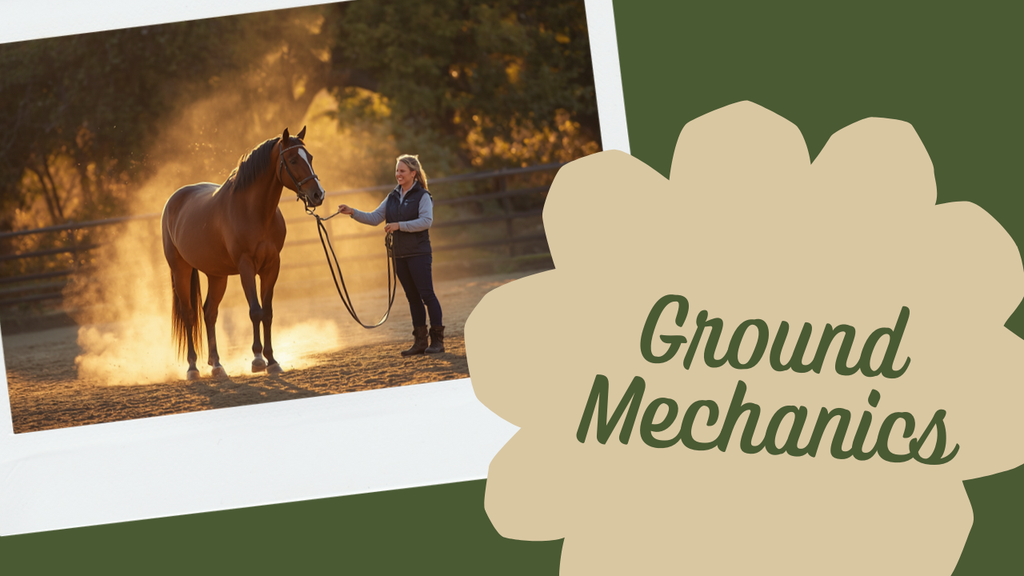
Course 102 — Ground Mechanics
The third course of the Level 1 Foundational Horsemanship Certification. Ground mechanics are where softness is actually built: the five manoeuvres that make a horse light, thinking, and safe before anyone climbs into a saddle. Lateral flexion, disengaging the hindquarters (your emergency brake), disengaging the forequarters, backing with feel, and desensitizing by approach and retreat, done so the horse gets braver rather than shut down.
The course finishes by putting it all together into a short pre-ride groundwork sequence you will run before every ride, and a troubleshooting method built on first principles: reduce the ask, feet first. If it does not work on the ground, you do not ask for it in the saddle. Certification at the end.
Soft is strong. Clarity is kindness.
| Responsible | Zachary Leyden |
|---|---|
| Last Update | 07/28/2026 |
| Completion Time | 5 hours 31 minutes |
| Members | 6 |
-
The Foundation (empty)4Lessons · 19 minSection 1 of 6. Everything so far was about the horse. This is where you start changing it. Groundwork is not a warm up and not a chore, it is the first chapter of the ride, and if you cannot get a thought on the ground you will not get a body in the saddle.
-
Why Groundwork Comes FirstGroundwork is not about moving feet, it is about moving a mind. Why the horse you get in the saddle was decided before you ever climbed on.Preview 10 xp
-
The Groundwork Toolkit: Halter, Lead, Flag, and StickRope halter, twelve foot lead, twenty two for distance, and a stick and string held like a paintbrush. What each tool does, how it is carried, and the one rule with no exceptions.New
-
Watch: Ray Hunt Starting a Colt (1982)Ray Hunt starting a colt in San Antonio around 1982. The archive footage this whole tradition rests on. Watch how little he does.New
-
Watch: Ray Hunt Starting a Colt, Part TwoThe second surviving clip from the same 1982 San Antonio session you just watched. Still no narration, and none needed. Watch what Ray does between the moments, because that is where the teaching is.New
-
-
Flexion (empty)4Lessons · 24 minSection 2 of 6. Softness is not a mood, it is a mechanical answer you can ask for and measure. Lateral flexion bends the neck and unlocks the ribs. Vertical flexion drops the poll and unlocks the jaw. Both are built the same way: ask, wait, release on the first try rather than the best one.
-
Lateral Flexion on the GroundBend the neck and the ribs unlock. The ask, the wait, and why the release has to come on the first try rather than the best try.10 xp
-
Vertical Flexion and the Soft FeelA full mug of coffee of weight, held dead steady, no pulsing, released the instant the poll drops. Five to eight repetitions is a session, and a straightening elbow means you are pulling.New
-
Watch: Lateral Flexion Leads to a Soft BackupHow lateral flexion turns into a soft backup. The link between the two exercises, shown rather than described.New
-
Watch: Ricky Quinn — Softness on a Green ColtRicky Quinn came up under Buck Brannaman. Here he shows flexion and yielding with feel, timing, and balance on a colt with sixty days of riding. This is where the flexion you just practiced is headed.New
-
-
Yielding the Quarters (empty)4Lessons · 16 minSection 3 of 6. The hindquarters are the engine and the forequarters are the steering. Learn to move each independently from the ground and you have both the emergency brake and the beginning of every manoeuvre in Level 2.
-
Disengaging the HindquartersThe hind legs cross under, the power goes out of the horse, and you have an emergency brake that works from the ground and from the saddle. The most important single thing in this course.10 xp
-
Disengaging the ForequartersThe shoulders are heavier and harder to move than the hindquarters, and moving them through thought rather than force is what separates a handler from a horseman.10 xp
-
Watch: Hindquarters ControlHindquarter control demonstrated cleanly. Watch the crossover of the inside hind leg, which is the entire point.New
-
Watch: Buck Brannaman — Four Ways to Move the HindquartersYou have the basic yield from the last video. Buck now shows four escalating ways to free the hindquarters, the same untracking Tom Dorrance built everything on. Notice he never skips to the stronger ask.New
-
-
Backing (empty)4Lessons · 21 minSection 4 of 6. A horse that backs softly is a horse that is listening. Three ways to ask, laddered from most obvious to most subtle, and a thirty second daily check that tells you what kind of day this is going to be.
-
Backing With FeelTeaching a horse to think backward before it steps backward. Three to five clean straight steps, released on the first shift of weight.10 xp
-
Backing From the Halter, the Chest, and the FeelHalter, then chest, then feel. A ladder from the most obvious ask down to a wrist wiggle along the rope, and what a consistently crooked backup is actually telling you.New
-
Watch: Backing Up SoftlyA soft backup built in real time. Notice that the release comes earlier than you expect it to.New
-
Watch: Bryan Neubert — Fixing the Braced BackupWhen the backup you learned above gets sticky or braced, this is the diagnosis. Neubert shows where the brace lives and how to melt it rather than fight it, on horses of any age.New
-
-
Desensitizing (empty)5Lessons · 52 minSection 5 of 6. There is a right way and a wrong way to make a horse braver, and for about a week they look the same. Approach and retreat builds confidence. Flooding builds a horse that has given up. This section teaches you to tell them apart in fifteen seconds.
-
Approach and Retreat: The Only Method That WorksThe retreat is the reward. Remove the stimulus on the first sign of release, and wait one calm heartbeat after a spook or you will reward the spook itself.New
-
The Flag, the Rope, and the TarpFlag, then rope, then tarp. Shoulder first, belly and hind legs last, each side taught separately, one beat per second no matter what happens.New
-
Desensitizing Versus Shutdown: How to Tell the DifferenceTwenty seconds without a blink means stop now. The fifteen second test that tells you whether you built confidence or shut a horse down, and exactly what to do if you did.New
-
Watch: Desensitizing Without FloodingDesensitizing done without flooding. Watch the horse get braver rather than quieter, which are not the same thing.New
-
Watch: Buck Brannaman — The Tarp ExerciseThe classic. Buck builds a colt's confidence with a tarp using pure approach and retreat, the exact method from the lessons above. Compare his timing of the retreat to what you watched in the last video.New
-
-
Putting It Together (empty)6Lessons · 1 hr 6 minSection 6 of 6. Ten steps, five to eight minutes, run before every ride for the rest of your life. The sequence that turns everything above into a single habit, plus the troubleshooting method for the days it does not go well.
-
The Groundwork Sequence: Your Pre-Ride CheckTen steps in a fixed order, five to eight minutes, before every ride. All normal means ride. Several off means you do not, and you say so.New
-
Troubleshooting: Reduce the Ask, Feet FirstUnderstanding, timing, or pain, diagnosed in that order, and when you cannot tell, assume pain. Three failed attempts means change something rather than repeat it louder.New
-
Watch: A Full Groundwork SessionA full groundwork session end to end. Watch it once for the sequence and again for the timing.New
-
Watch: Bryan Neubert — Preparing a Colt for the Saddle, UncutTwenty-four minutes, no cuts. Every piece of this course, flexion, yielding, backing, desensitizing, flowing together as Neubert prepares a colt for its first saddle. This is your groundwork sequence performed at the highest level, and it is the bridge to Course 103.New
-
Watch: Ray Hunt — Trailer LoadingRay himself, applying the whole toolkit to a real job: loading a horse in a trailer. The cowboy way and Ray's way, side by side. When your groundwork is honest, the trailer is just another question.New
-
Watch: Warwick Schiller — Trailer Loading Below ThresholdYou watched Ray load a trailer in the video above. Now the same job a generation later, done entirely through relaxation and staying under the anxiety threshold. Two eras, one principle: the horse loads itself when it is ready.New
-
-
The Certification (empty)1Lessons · 30 minThe five manoeuvres, tested. Ten questions, eighty percent to pass. Your safety in the saddle rests on this course, so the questions ask why as often as how.
-
Course 102 CertificationTen questions on the five manoeuvres and the judgment around them. If the hindquarter yield question gives you pause, go back to section 3.New
-
-
Go Deeper (empty)6Lessons · 1 hr 43 minThe encore. The people who built this method left footage behind. How to study it without copying the surface and missing the point, plus an afternoon at the fence with Tom Dorrance and a profile of Joe Wolter.
-
Studying the Masters on the GroundHow to study old footage without copying the surface. What to look for in Dorrance, Hunt, and Brannaman, and what you will miss on a first viewing.New
-
Watch: Through the Corral Fence with Tom DorranceGustine, California, 1995: Tom Dorrance helping Martin Black, Terry Church, and Bryan Neubert work through problems, teasing and teaching from the fence. This is what studying under the source looked like.New
-
Watch: Meet Joe WolterJoe Wolter worked for Ray Hunt and studied under both Dorrance brothers. A quiet profile on feel and adjusting to fit the horse, the mindset behind every manoeuvre you drilled in this course.New
-
Watch: Clinton Anderson — Control and Respect on the GroundThe wider world: Clinton Anderson's Downunder method is the most drilled, most structured groundwork system in America. Watch it critically with your Leyden eyes: where is the release, how big is the ask, and what would softer look like? Disagreeing well is part of your education.New
-
Watch: Clinton Anderson — Desensitizing a Rescue HorseA full desensitizing session with a fearful rescue mare, from a more pressure-forward school than ours. Compare it to Buck's tarp work and Warwick's below-threshold approach: same goal, different dials. Decide for yourself what the mare would say.New
-
Watch: Pat Parelli — The Seven Games in Three MinutesThe most widely taught groundwork system in the world, condensed by Pat himself. As you watch, map each game onto the manoeuvres you learned in this course; the vocabulary differs, the mechanics rhyme.New
-