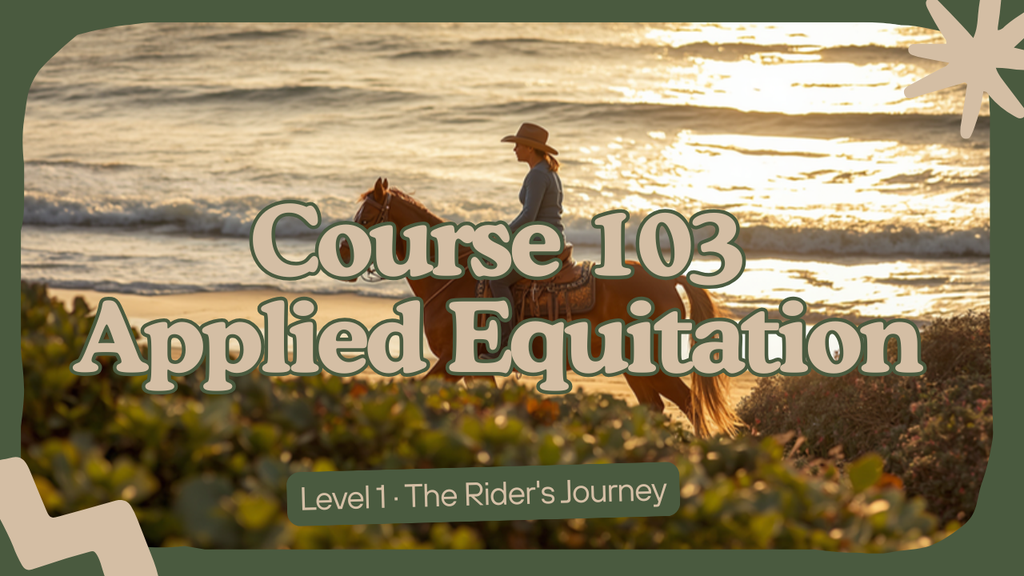
Course 103 — Applied Equitation
The final course of the Level 1 Foundational Horsemanship Certification. Everything you built on the ground now happens in the saddle: the pre-ride check, mounting safely, the independent seat and independent hands, steering with the direct rein and then the neck rein, transitions, and the stop, including the one-rein stop drilled until it is reflex.
The course ends where Ocean View Stables begins: riding out. Trail etiquette, hills, water, and the beach ride, treated as what it is, an extension of your horsemanship and not a casual excursion. Finish with your certification, then talk to us about the Student Assistant Program and where the journey goes after Level 1.
Soft is strong. Clarity is kindness.
| Responsible | Zachary Leyden |
|---|---|
| Last Update | 07/28/2026 |
| Completion Time | 7 hours 24 minutes |
| Members | 1 |
Intermediate
-
Before You Mount (empty)3Lessons · 27 minSection 1 of 6. The three minutes before your foot goes in the stirrup decide most of what follows. The cinch, the stirrups, the off side billet, a short groundwork check, and an honest look at your own state that day.
-
The Pre-Ride CheckCinch re-checked after walking, stirrups measured then counted on both sides, the off side billet checked every single ride, and three minutes of groundwork before your foot leaves the ground.Preview New
-
Mounting and Dismounting SafelyReins gathered before the foot goes in the stirrup, and the horse stands until asked. Block mounting by default here, ground mounts learned facing the tail, and both feet out before any dismount.New
-
Watch: Mounting as a Willing PartnershipMounting treated as something the horse agrees to rather than tolerates. Watch how long he waits.New
-
-
The Seat and the Hands (empty)7Lessons · 1 hr 22 minSection 2 of 6. Ear, shoulder, hip, heel. A seat that does not depend on the reins, and hands that do not depend on the seat. This takes months rather than weeks, and the rest of riding waits on it.
-
The Independent SeatEar, shoulder, hip, heel on one line. The chair seat and the fork seat, why each one happens, and why a usable seat is counted in months and not in lessons.New
-
Independent HandsA straight line from elbow to bit, thumbs up, a fist apart. A full mug of tea of weight, held like a small bird. Lose your balance and you grab mane, never the reins.New
-
Finding Your Balance at the WalkLeft hind, left fore, right hind, right fore. Four beats, no suspension, and a halt asked with an exhale and three full seconds of no rein at all.New
-
Watch: Riding With Correct Aids — Buck BrannamanBuck Brannaman on correct aids. The reference standard for everything in this section.New
-
Watch: Tom Dorrance — Riding with Feel, Timing and BalanceYou heard Tom name the three pillars back in Course 100. Here he teaches them under saddle. After Buck's nearly invisible aids in the last video, watch where Buck learned it from.New
-
Watch: Peter Campbell — The Art of Being a RiderPeter Campbell rode with both Ray Hunt and Tom Dorrance. A full chapter on the seat, feel, and how you present yourself to the horse. Long, and worth every minute once the two videos above have set the frame.New
-
Watch: Ken McNabb — Riding With Correct Body PositionA full practical lesson on seat, leg, shoulder, hand, and eye for the everyday rider. After Tom and Peter Campbell set the philosophy, this is the nuts-and-bolts checklist to ride with.New
-
-
Steering (empty)4Lessons · 36 minSection 3 of 6. Eyes, weight, legs, rein, in that order, every time, with a full stride of waiting before the rein. The direct rein, the neck rein, and the honest test of whether you taught one or merely pressed a neck.
-
The Direct ReinThe hand opens sideways, never crossing the withers and never pulling back. Nose, then shoulder, then feet, and the release comes on the thought rather than the turn.New
-
The Neck ReinLay the new cue first, wait a second, then the known one. Hundreds of repetitions. If the neck is firmly pressed you are not neck reining, you are pressure training.New
-
Seat, Leg, and Rein TogetherEyes, weight, legs, rein. Inside leg at the girth, outside leg back to hold the hindquarters on the arc, and one full stride of waiting before the hand does anything at all.New
-
Watch: From Direct Rein to Neck ReinThe move from direct rein to neck rein, shown across a session. Watch the timing between the two cues.New
-
-
Gaits, Transitions, and Stops (empty)6Lessons · 49 minSection 4 of 6. Four beats at the walk, two at the trot, and a transition that starts in your body three strides before it starts in the horse. Then the stop, and the one rein stop, drilled until it is reflex rather than a decision.
-
Walk, Trot, and Sitting the JogWalk, trot, and the jog, which is the same trot ridden slow and flat. Post the trot, sit the jog, and rise as the outside foreleg goes forward.New
-
Transitions: Upward and DownwardPrepare three or four strides out at a named marker, ask seat first and hand last, release on the first response. The half halt is a downward ask cancelled before it lands.New
-
The Stop and the One-Rein StopDrop the outside rein completely, grab mane first, slide down and anchor at the hip. Never both reins on a bolting horse. A rider who cannot do this on both sides does not ride out here.New
-
Watch: One-Rein ControlOne rein control demonstrated. Watch the anchor point, and notice there is no pulling once it is set.New
-
Watch: Martin Black — Rating Speed in the CircleMartin Black rode with Tom and Ray in Idaho. Rating rhythm and speed in circles is the foundation under every clean transition you drilled in this section.New
-
Watch: Warwick Schiller — Relaxation Under SaddleMartin Black gave you rhythm; Warwick adds relaxation, with an anxious horse that changed how he trains. Rhythm and relaxation together are what make every transition in this section soft.New
-
-
Riding Out (empty)6Lessons · 56 minSection 5 of 6. The trail is where horsemanship gets tested by things you did not choose. Spacing, ribbons, gates, hills, water, and the beach, treated as an extension of your training rather than a reward for finishing it.
-
Trail Etiquette and AwarenessOne horse length minimum, red ribbon means kicker, every hazard called down the line, and the pace set by the least confident horse in the group.New
-
Hills, Water, and ObstaclesThe head and neck are about ten percent of the horse and they are the balance lever. Long rein on slopes and in water, straight up and straight down, and never traverse a steep face.New
-
The Beach RideTide table before you leave, wet firm sand for footing, deep dry sand at a walk only. The one rein stop signed off on both sides is the price of admission, and nobody gallops on a first beach ride.New
-
Watch: Solving Jigging on the TrailSolving a horse that jigs on the trail. A common problem, fixed by changing the rider first.New
-
Watch: Bryan Neubert — Freed Up Outside the PenFence work and trailer loading as one continuum: the horse staying soft and free outside the arena. This is the groundwork-to-outside bridge your trail riding depends on.New
-
Watch: Julie Goodnight — The Spooky Trail HorseA full episode on fixing a horse afraid of its own shadow on the trail, with rider safety front and center. Watch how much of the fix happens on the ground before anyone rides.New
-
-
Long-Term Growth (empty)5Lessons · 2 hr 12 minSection 6 of 6. What a sustainable routine looks like, what Level 1 has actually made you, and where the road goes from here. Read the last lesson slowly. It is the one people come back to.
-
Building Your RoutineWhat frequency actually does to skill retention, why progress falls off sharply below one lesson a week, and how to use the weeks in between.New
-
After Level 1: Where the Journey GoesWhat Level 1 made you, what comes next, the lope, the Student Assistant Program, and Level 2. The last lesson in the certification, and the one worth reading twice.New
-
Watch: Remembering Ray HuntA fifty two minute interview on a lifetime with horses. Save it for an evening when you have time to sit with it.New
-
Watch: The Real Tom DorranceThe bookend to Remembering Ray Hunt above: a full hour on Tom, told by his close collaborator John Saint Ryan. You started Course 100 hearing Tom name feel, timing, and balance. End here, hearing what a lifetime of it added up to.New
-
Watch: Stacy Westfall — The Bridleless Championship RideWhere can this journey lead? Here: the 2006 Congress freestyle, bareback and bridleless, ridden on nothing but seat, legs, and trust. Every cue you are learning in this program, with the reins gone.New
-
-
The Certification (empty)1Lessons · 30 minThe last gate in Level 1. Ten questions across the saddle, the trail, and the calls you have to make on your own. Pass this and the rest of your certification happens at the barn, in front of three instructors.
-
Course 103 CertificationTen questions across the saddle, the trail, and the judgment calls. The last gate in Level 1 before the barn takes over.New
-
-
Go Deeper (empty)4Lessons · 32 minThe encore. Habits for the next twenty years, from people who were still learning after fifty.
-
The Long Ride: A Horseman's HabitsThe habits that keep a horseman learning long after the certificate is framed. Short, and worth returning to once a year.New
-
Watch: Buck Brannaman — Flatwork That Builds SoftnessBuck's essential ridden flatwork from 7 Clinics: the exercises that turn correct aids into a soft, correctly carried horse. Short, dense, and worth watching more than once.New
-
Watch: Buck Brannaman — Words of WisdomBuck in the clinic Q&A chair on horsemanship, tack, and the relationship underneath it all. The voice of this lineage answering the questions students actually ask.New
-
Watch: Guy McLean — Liberty and LightnessAn arena demonstration of extreme softness: multiple horses at liberty, responding to almost nothing. Not a method to copy, a ceiling to aim at. Notice he narrates his releases the whole way through.New
-